Showing posts with label fine motor skills. Show all posts

Monday, August 27, 2012

Activity Guide: The Button Bear Weighted Lap Pad

The team at Achievement Products asked our consultant, Occupational Therapist Scott Russo, to provide some activity suggestions for incorporating some of our favorite items into daily classroom activities or curriculum.

Scott has provided some really great and creative ways to use items (that may have been originally designed for typically developing children), in special needs environments.

Today we will look at the Button Bear Weighted Lap Pad


Introduction:

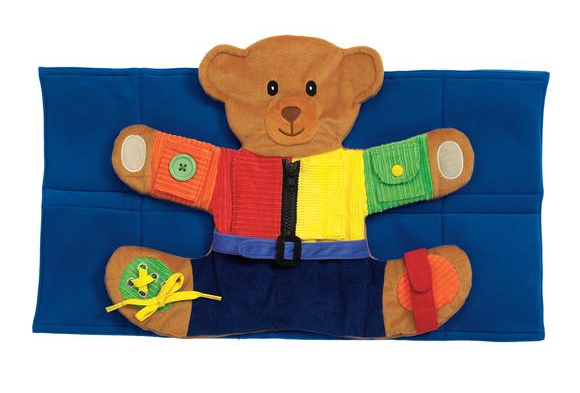
Providing both a weighted lap pad and a bear with several different options for developing dressing skills, the Button Bear Dressing Skills Lap Pad is perfect for developing the fine motor skills needed for buttoning, zipping, tying, and additional dressing skills while providing the option of a weighted lap pad for improved sensory regulation. The detachable bear allows the pad and the bear to be used separately or in conjunction with each other. The colorful and charming nature of the bear provides a naturally engaging dressing toy that will entertain children for extended periods. The fabric was also designed to assist with tactile processing skills, providing several different textures that should be pleasing, even to the tactile defensive child.


Activity Ideas:

• Add the weights into the pad and place the pad on the child’s lap during classroom or community activities that require a child to maintain a seated position or long periods of focus such as circle time, church, car rides or dining out. The weighted nature of the pad will provide proprioceptive input and the bear will provide fidget toys, both of which should assist the child with self-regulation and attentional focus.


• The bear is attached to the pad with hook and loop. Have the child pull the bear off the pad and reattach. This exercise will help develop strength in the hands and arms and also improves motor planning.


• Place the pad (with or without weights) on the child’s lap with the bear’s feet facing the child’s belly. Experiment with the different dressing items.


• Switch the orientation of the bear so that the head is against the child’s belly and experiment with dressing from this direction. The change in orientation will provide a different challenge for the child but is also closer to the perspective of dressing themselves.


• Have the child remove the bear from the pad. Using just the bear, the child can engage in pretend play with the bear as if it were a typical doll.


• With the bear removed, the pad can be used as a regular weighted lap pad for proprioceptive input.


• The bear itself can also be used as a portable and socially appropriate fidget toy for holding attention and self-regulation.


For more information about the Button Bear Weighted Lap Pad and other great items please visit http://www.achievement-products.com.


Wednesday, August 1, 2012

Activity Guide: Tobbles™


The team at Achievement Products asked our consultant, Occupational Therapist Scott Russo, to provide some activity suggestions for incorporating some of our favorite items into daily classroom activities or curriculum.

Scott has provided some really great and creative ways to use items (that may have been originally designed for typically developing children), in special needs environments.

Today we will look at Tobbles™.


Introduction:


Tobbles is an almost full-proof balancing/nesting game. Each piece is designed to be able to balance in numerous positions to create multiple different tower configurations. Most importantly, Tobbles allows kids to be successful in stacking while working on fine motor skills. Used in a group, kids can work on turn-taking, social skills, teamwork, and cooperation.


Activity Ideas:


·        Simple stacking activities. Let the child be creative with his/her designs.


·        Group activities. Take turns stacking the pieces.


·        Sequencing activities. Give the child a sequence of colors or sizes for stacking and see if they can follow the sequence from memory.


·        Color matching. Stack the blocks according to matching colors.


For more information about Tobbles™ and other great items please visit http://www.achievement-products.com.  


Monday, April 9, 2012

Anna Reyner - The Fine Art of Scribbling


This post is authored by Anna Reyner, a registered art therapist and licensed marriage and family therapist. Anna is a nationally recognized arts advocate that has conducted over 500 hands-on art workshops for learners of all abilities. Follow Anna’s blog at Art and Creativity in Early Childhood Education.


The Fine Art of Scribbling


Children’s scribbles were once conceived of simply as practice for “real drawing,” but educators today recognize that scribbling is an important step in child development. Scribbling is the foundation of artistic development and is intimately linked with language acquisition. Young children love to scribble and adults will enjoy it too, if you give them permission to “let loose with a crayon".


Scribbling reflects a child’s physical and mental process. When toddlers first pick up a crayon and make a mark, they experience a pleasurable moment in which they use a tool and produce a result. They don’t realize they are taking the first step of a long journey, a journey that will culminate around the age of 8 with a mastery of line that is remarkably controlled. They only know that in this powerful moment, something they did with their body created a visible result and that feels very exciting.


<><> <><> <><> <><> <><> <><>
This scribble drawing is from Mona Raoufpour’s 4 year old classroom at Pressman Academy in Los Angeles. Mona artfully links children’s early drawings to language and literacy. Early in the school year, many of her students are immersed in the scribble stage or just moving into more representational drawings. Mona takes meticulous dictations and mounts them directly onto children’s scribble drawings as shown here. Without this detailed dictation, who would ever know that Noah, this young artist, has a story in his mind about a “big monster who ate broccoli then fell down and broke his face and arm and leg.”


Mona has her 4 year olds work on long term book making projects that include scribble drawings with dictations. Children are indeed natural storytellers, and scribbling is how their visual story telling begins.


No study of scribbling would be complete without mention of Rhoda Kellogg. Kellogg was a pioneer in the study of analyzing children’s art. Over the course of 20 years, Rhoda Kellogg collected and analyzed over 1 million children’s drawings from children ages 2-8. In 1967, she published an archive of 8000 drawings of children ages 24-40 months, focusing on scribbling and the early “ages and stages” of child development. Kellogg concluded that children need plenty of time for free drawing and scribbling to develop the symbols that will later become the basis for all writing and drawing. Before Kellogg, scribbles were considered nonsense. Children were discouraged or even forbidden from scribbling, and encouraged to copy adult models (sounds ghastly and misguided, but this shows how far we’ve come in understanding child development.).


Stages of Scribble
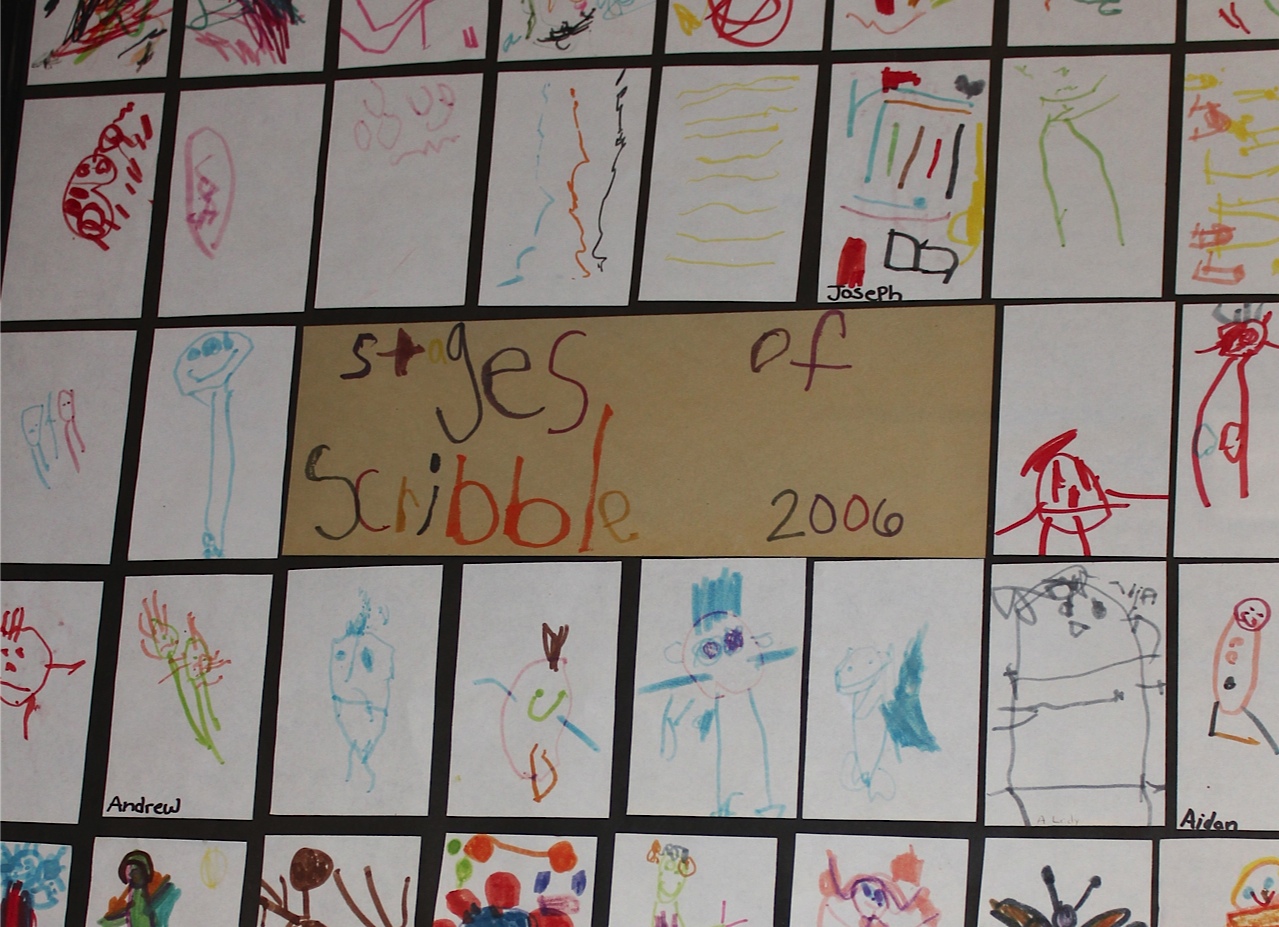
Here's something creative to do with scribble drawings - check out the "Stages of Scribbles" created by children at the Alpert Jewish Community Center in Long Beach, CA. Assistant Director, Alayna Cosores, asked teachers to contribute examples of scribbles and compiled them into an Ages & Stages frame that hangs in their Early Childhood Office. Not only is it colorful and fun to look at, "Stages of Scribble" reminds parents that scribbling is an important process to encourage at home. Why not try something like this in your own center, it costs so little to put together and will provide years of stimulating conversation.


Last but not least, scribbling is not just for kids…it can also be liberating for adults! Scribbling is a physical process that emphasizes freedom of movement. It can help us relax and get into the sensory mode of our bodies as well as the creative, right hemisphere of our brain. With this in mind, I often begin Teacher Trainings with some form of a scribble warm-up. My favorite is a paired up exercise called a “Scribble Chase.” Click here for the printable lesson plan from my book Smart Art Ideas 2. While the original lesson plan used Colorations® Liquid Watercolor for the top layer, I’ve come to enjoy it even more using Colorations® No-Drip Foam Paint


Scribbling is it’s a great way to energize a room.  I suggest you try “grown-up” scribbling sometime soon.

Thursday, January 5, 2012

Smash Painting

This post is authored by Anna Reyner, a registered art therapist and licensed marriage and family therapist. Anna is a nationally recognized arts advocate that has conducted over 500 hands-on art workshops for learners of all abilities. Follow Anna’s blog at Art and Creativity in Early Childhood Eduation.

Special Needs Application:
Perfect for children with impaired fine motor skills.

Try a new technique that kids and adults both have fun with - it's called "smash painting." Smash painting releases lots of energy and let's active children have fun making dots of splashing color. When you use a completely washable paint like Colorations® Liquid Watercolorthere's no worry about making a mess.
How to begin? First get yourself some sponge tip plastic bottles (called bingo bottles) and a variety of Colorations® Liquid Watercolor paint. Fill each bottle with a different color. You'll need white construction paper, and if you want to make a portrait like the one pictured here, you'll need markers for the details in the portrait itself. Smash painting is used for the background in the example shown.


Next, practice smash painting and develop some skill with it by experimenting on a piece of scratch paper. Simply turn your bingo bottle upside down and bang it lightly onto your paper, creating a dot with splash marks coming out from the sides. Try banging the bingo bottle lightly, then harder, and watch how your result changes. Switch colors and overlap splash marks, creating a pattern. Now try making lines and shapes with your bingo bottle and experiment with different effects you can achieve by simply dragging your bingo bottle slowly across the page. Once you've practiced and gotten a feel for your materials, you're ready for your final picture.

The picture or portrait shown here combines watercolor markers in the more controlled figure drawing, with smash painting in the background. The contrast of these two techniques makes an interesting self portrait. To create a portrait like this, first present your class with markers and have them create a central drawing of their choice - in this case, a portrait of themselves. Then demonstrate the smash painting technique and suggest they use this technique for their background. First spend practice time with smash painting. The have children return to their self portrait and smash painting the background. The painting shown here was done with a group of first grade students during one 45 minute art session.